


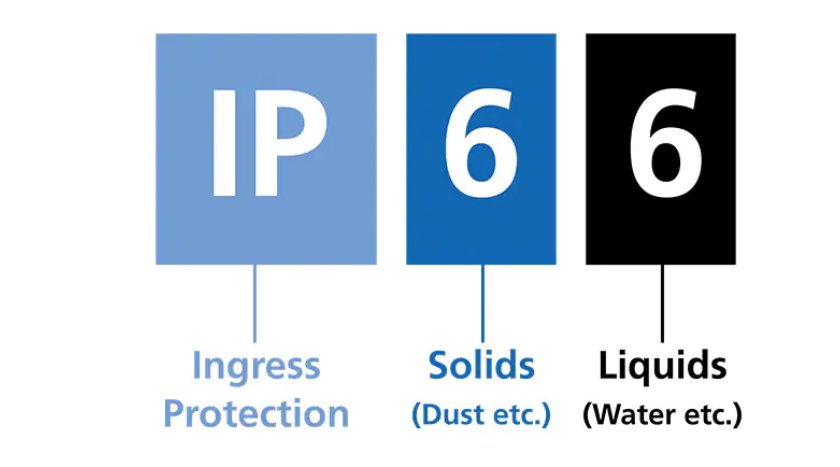
What is IP zoning, especially for bathrooms? We have also written about IP rating in general, but what about the IP zones in a bathroom? To illustrate the IP zoning regulations, we have divided the bathroom into areas or "zones", which are classified using the numbers 0, 1, 2 - see the illustration below.
Luminaires - the bathroom lights - are then assigned a certain "IP rating" which indicates how much protection they provide against ingress of water and other particles.
Each zone has a minimum IP requirement that must be met if a fitting is to be installed in this area.
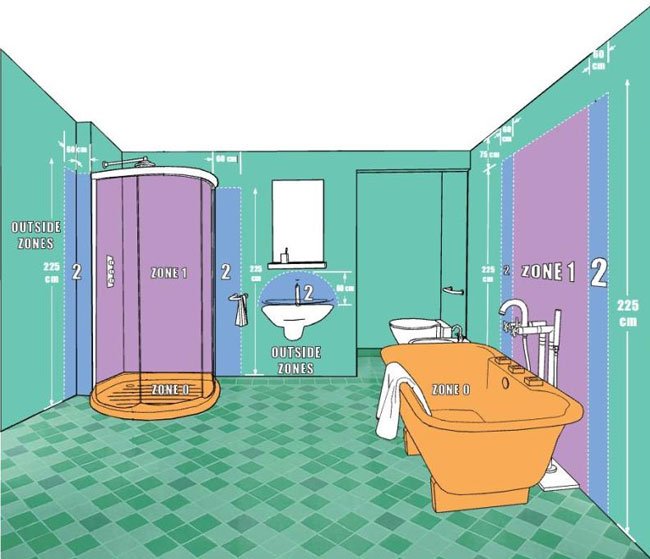
IP zoning
- Zone 0 - Inside the bath or shower. Any fittings used here must be SELV (Separated Extra Low Voltage - max. 12Volts) and have a minimum rating of IPX7 (IP67) (protected against immersion in water - total immersion proof);
- Zone 1 - Above the bath or shower to a height if 2.25m. Recommended IP rating: IP65. In this zone, if there is likelihood of water jets being used for cleaning purposes, a minimum of IPX5 is required. Also, subject to IP rating, SELV or 240V luminaires may be used in this zone; ff the fitting is 240 volts, a 30mA residual current device (RCD) must also be used to protect the circuit in this zone.
- Zone 2 - The area stretching to 0.6m outside the bath or shower and above the bath or shower if over 2.25m. An IP rating of at least IPX4 (IP44) is required. In this zone, if there is likelihood of water jets being used for cleaning purposes, a minimum of IPX5 is required. Also, subject to IP rating, SELV or 240V luminaires may be used in this zone. In addition, it is a good practice to also consider the area around a wash basin (within a 60cm radius of any tap) as Zone 2.
- Outside the zones - anywhere outside zones 0, 1, and 2. Where water jets are not to be used for cleaning purposes, the general rules of BS7671 apply. Here, there is no requirement for any lighting solutions to be protected against particles or solid objects, e.g. IPX4 - no IP rating required.
IP ratings explained (IP = Ingress Protection)
- The first digit - protection against ingress of foreign bodies, like: tools, dust, fingers, etc.
- The second digit - protection against ingress of liquids. Ex. IP44 offers protection against solid objects greater than 1 mm and water sprayed from all directions.
The first digit - protection from foreign bodies
- 0 - no protection from foreign bodies;
- 1 - protected against solid objects greater than 50mm (e.g. accidental touch by hands);
- 2 - protected against solid objects up to 12mm (e.g. fingers);
- 3 - protected against solid objects greater than 2.5mm (e.g. tools and wires);
- 4 - protected against solid objects greater than 1mm (e.g. small tools and wires);
- 5 - protected against dust, limited ingress (e.g. no harmful deposit);
- 6 - totally protected against dust. For example see this IP66 rated light fitting.
The second digit - protection from liquids
- 0 - no protection from liquids;
- 1 - protection against vertically falling drops of water(e.g. condensation);
- 2 - protection against direct sprays of water up to 15 degrees from vertical;
- 3 - protection against direct sprays of water up to 60 degrees from vertical;
- 4 - protection against water sprayed from all directions - limited ingress permitted;
- 5 - protected against low pressure jets of water from all directions - limited ingress permitted. See this IP65 rated light fitting as an example.
- 6 - protected against high pressure jets of water (use on ship deck) - limited ingress permitted;
- 7 - protected against the effects of immersion between 15cm and 1m;
- 8 - protected against long periods of immersion under pressure.
Update to IP Ratings in 20 March 2015
As a result of European standardisation, Amendment 1 of the 17th addition of the IEE Wiring Regulations (BS7671) came into effect in July 2011. Here are some of the updates:- Zone 0 in the bathroom is the interior of the bath tub or shower basin. For showers without a basin, the height of zone 0 is 0.10m and its surface extent has the same horizontal extent as zone 1. (More: Regulation 701.32.2 of BS7671)
- Zone 1 in the bathroom is limited by:
1. The finished floor level and the horizontal plane corresponding to the highest fixed shower head or water outlet or the horizontal plane lying 2.25m above the finished floor level, whichever is higher.
2. The vertical surface:
a) Circumscribing the bath tub or shower basin (see Fig. 701.1)
b) At a distance 1.20m from the centre point of the fixed water outlet on the wall or ceiling for showers without a basin. Zone 1 does not include zone 0. The space under the bath tub or shower basin is considered to be zone 1. However, if the space under the bath tub or shower basin is only accessible with a tool it is considered to be outside the zones (More: Regulation 701.32.3 of BS7671) - Zone 2 in the bathroom is limited by:
1. The finished floor level and the horizontal plane corresponding to the highest fixed shower head or water outlet or the horizontal plane lying 2.25m above the finished floor level, whichever is higher.
2. The vertical surface at the boundary of zone 1 and the parallel vertical surface at a distance of 0.60m from the zone 1 border. For showers without a basin, there is no zone 2 but an increased zone 1 is provided by the horizontal dimensions of 1.20m mentioned in Regulation 701.32.3(ii) - For anything outside zones 0, 1 and 2 this is treated as 'outside of zones', therefore no IP requirement (More: Regulation 701.32.4 of BS7671)

